Community service project · first runner-up in APICTA Taiwan
VoiceChess
An accessible chess app for visually impaired players, with talkback, voice-controlled moves, real-time audio feedback, adjustable speech speed, and intelligent assistance.
The problem
Why does visually impaired chess players lose to sighted players? Not because they cannot see the board, but because learning materials (game analyzer, puzzles, and courses) in other chess apps are not accessible, they don't support talkback.
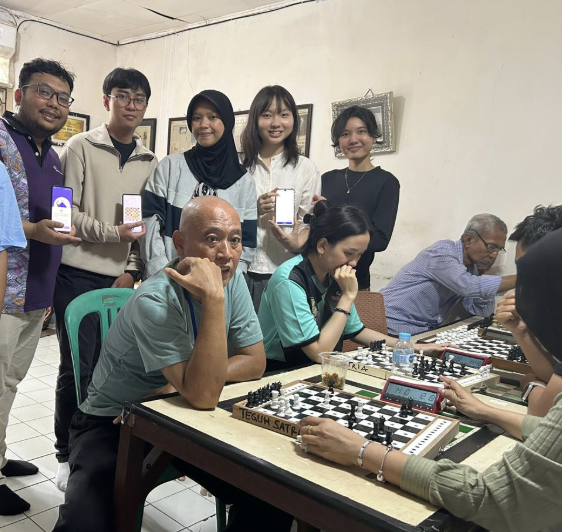 Visually impaired chess community
What it does
- Voice Navigation: Complete voice-guided interface
- Audio Announcements: Clear spoken move notifications and board state
- Screen Reader Support: Fully compatible with JAWS, NVDA, VoiceOver, TalkBack
- Customizable Audio Cues: Personalize sound feedback
- Descriptive Notation: Algebraic notation with audio output
- AI Training Mode: Practice with different difficulty levels
Technical Challenges
The challenge that I faced during development was balancing LLM latency with token cost.
One of the main technical challenges I encountered was the game analyzer. For each position in a chess game, the system uses an LLM to generate an explanation of the recommended move. If we generated the explanation only when the user reached each move, navigating through the game would feel slow because every new position could require an additional LLM request. A simple solution would be to precompute and cache the analysis for the entire game. However, this would waste tokens because users might only analyze the first few moves before leaving the page. I solved this by using the user's progress as a signal of their interest. Instead of generating analysis for the entire game upfront, the system progressively prefetches more moves as the user continues analyzing. For example, reaching move 20 is a stronger indication that the user is genuinely interested in analyzing the game than reaching move 5. This creates an adaptive trade-off between latency and LLM cost. Early in the analysis, we minimize unnecessary token usage. As the user's engagement increases, we invest more tokens in prefetching future analysis so that subsequent moves can be displayed with little or no waiting time.
My role
I worked as the backend developer, responsible for designing and implementing the backend services supporting chess games, voice interactions, and AI training functionality. I also worked closely with the frontend developer to define APIs and ensure that accessibility settings and voice interactions were consistently reflected across the application.
Impact
VoiceChess has been well-received by the visually impaired chess community, providing an inclusive platform for players to enjoy the game. The app has improved accessibility in chess, allowing visually impaired players to compete on equal footing with sighted players.
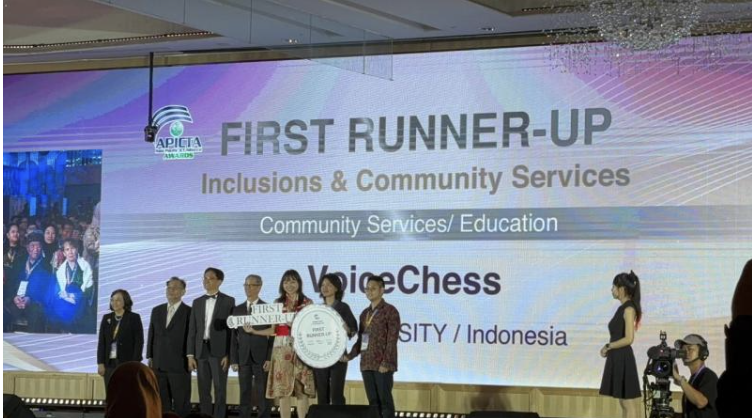 Winning first runner-up in APICTA taiwan